
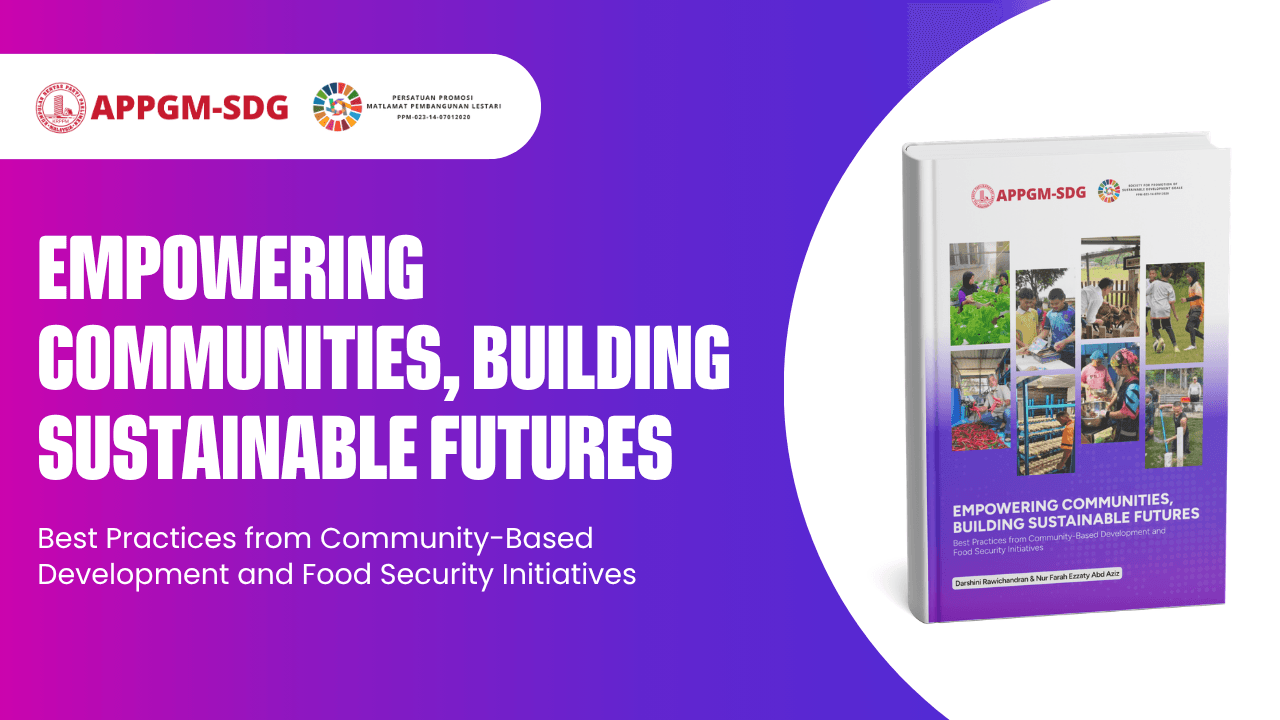
Best Practices from Community-Based Development and Food Security Initiatives

A shared processing hub in Kampung Kuyungon, Tambunan, Sabah, where surplus vegetables become powders and pickles instead of spoiling in the field. A piece of clay, centred and shaped by hands in Petaling Jaya, Selangor, that became both a craft and a form of quiet healing. A pot of dodol stirred in Kampung Serting Ilir, Negeri Sembilan, a step toward turning a recipe woman already knew into new income. These are three of the sixty projects gathered in this book, each one proof that meaningful change rarely announces itself. It shows up in a processing room, a pottery wheel, and a kitchen.
Empowering Communities, Building Sustainable Futures: Best Practices from Community-Based Development and Food Security Initiatives presents sixty case studies from APPGM-SDG’s 2025 portfolio, evenly split between the Community-Based Development Project (CBDP) and the Food Security (FS) Initiative, and representing all six of the country’s implementation areas: Central, East Coast, North, South, Sabah and Sarawak.
Behind these sixty case studies sits RM2,225,000 in community-level funding channelled through the Ministry of Finance Malaysia, covering everything from first-time grassroots ventures to continuation grants for initiatives that had already proven themselves. The beneficiaries span women, youth, persons with disabilities, farmers, Indigenous communities, students and asnaf households, working across economic, social and environmental priorities, delivered through a mix of social enterprises, NGOs, universities, cooperatives and community associations.
What ties these sixty stories together is not the outcome but the process behind it, needs identified before funding was approved, guidance offered throughout, and results reviewed honestly at the end, setbacks included. Delays, capacity gaps and market access issues appear in this book alongside the wins, because a true record of grassroots development has to hold both.
This publication is written for the people who will use it, policymakers, practitioners, solution providers and community leaders, as a practical resource: real, tested approaches to community development and food security that can be examined, adapted and carried further across Malaysia.